
If you’re evaluating garment manufacturers for your womenswear line, the supplier’s supply chain model will shape everything – your lead times, your cost per unit, your quality outcomes, and how much control you actually have. Here’s a direct comparison to help you decide.
Quick Comparison: Vertical Integration vs. Nominated Suppliers
| Dimension | Vertically Integrated Manufacturer | Nominated Supplier Model |
| Fabric sourcing | Handled in-house by the manufacturer | Your brand specifies and nominates fabric suppliers |
| Cost control | Lower – fewer markups between stages | Variable – depends on your nominated suppliers’ pricing |
| Lead time | Shorter – all stages coordinated internally | Longer – dependent on multiple external parties |
| Quality consistency | Higher – one QC system across the chain | Higher risk – quality gaps between suppliers |
| Transparency | Full visibility of one facility | Partial – you see your nominations, not the manufacturer’s relationships |
| Brand control | Lower for fabric selection; higher for output | High for fabric; shared for production outcomes |
| Minimum order flexibility | Set by one facility’s capacity | Can vary – some stages have separate MOQs |
| Sustainability traceability | Easier – fewer chain-of-custody steps | More complex – each nominated supplier needs separate certification |
What Is Vertical Integration in Garment Manufacturing?
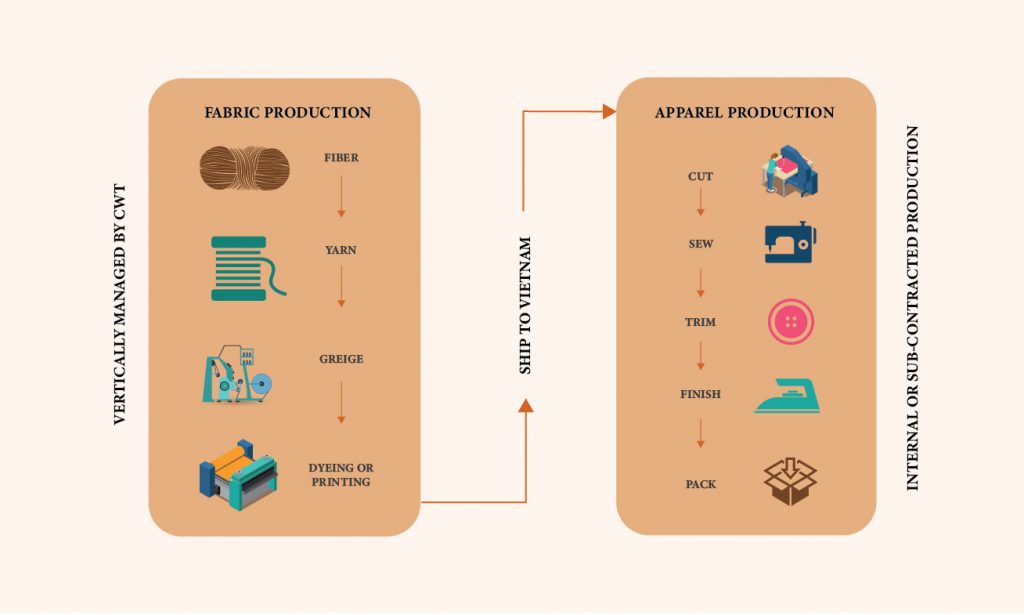
A vertically integrated manufacturer controls the full production chain from a single facility or closely linked operations. That includes fabric and trim sourcing, pattern making, sampling, bulk production, QC, packing, and export.
The key advantage for your brand: fewer handoffs. Every stage is managed under one roof, one quality system, and one commercial relationship. When something goes wrong – and in production, something always does – there’s one team to call.
For sourcing managers, this typically means shorter sampling cycles, more predictable lead times, and lower landed costs. There’s no third-party fabric mill adding its own margin between your manufacturer and the mill gate.
What Is the Nominated Supplier Model?
With nominated suppliers, your brand specifies which fabric mills, trim suppliers, or component vendors the manufacturer must use. You retain control over material selection – useful when you have existing mill relationships, specific fabric development underway, or brand-mandated standards that the manufacturer can’t meet through their own network.
The tradeoff is coordination overhead. Your nominated mill ships fabric to the garment factory on its own schedule. Delays, quality discrepancies, or minimum order mismatches between the mill and the manufacturer become your problem to manage.
This model works best when your brand has a dedicated sourcing team with the bandwidth to manage multiple supplier relationships across a single order.
The Advantage of Choosing a Vertically Integrated Apparel Manufacturer
For B2B fashion brands evaluating manufacturers, the supply chain model shapes every commercial outcome — lead times, quality consistency, cost structure, and sustainability traceability. Vertical integration consolidates all production stages under one facility and one quality system. Here is what that means in practice.
Shorter Lead Times — One Facility, No External Dependencies
A vertically integrated manufacturer coordinates fabric delivery, cutting, and production internally. There is no external mill to chase, no freight invoice between stages, and no separate commercial negotiation per season. Capital World Group delivers a 10-day sample turnaround — possible because fabric sourcing and sampling happen within the same operation.
With fragmented or nominated supplier models, lead time is the cumulative sum of every party’s schedule. A one-week delay from a nominated fabric mill pushes the entire production timeline. For brands working to retail deadlines, this is where fragmented supply chains most visibly fail.
Quality Consistency — One QC System Across the Full Chain
Vertical integration means one quality framework governs raw materials, cut panels, and finished goods. Inspectors at the facility can flag fabric issues before they become cut components — an early-stage intervention that isn’t available when fabric arrives from an external mill with its own inspection regime.
Capital World Group’s quality system is certified to ISO 9001, covering the full production chain from fabric intake through export — not only the cut-and-sew stage.
With nominated supplier models, brands must either trust each external party’s quality processes or build an additional inspection layer at every stage. Both add cost or risk to the supply chain.
Cost Structure — Fewer Margin Stages Between Fabric and Finished Good
A vertically integrated manufacturer eliminates the margin that a third-party fabric mill adds between the mill gate and the factory floor. For brands sourcing through Capital World Group, fabric is procured through a 40+ year supplier network — from basic cottons and wovens to high-tech jerseys and jacquards — with no additional intermediary markup.
The cost advantage is most evident on repeat programmes and seasonal orders, where the consistency of the fabric relationship enables tighter cost-per-unit control. [CONFIRM: If CWG has a cost comparison example for a representative 500-unit order, add here.]
IP Protection — Designs Stay Within One Commercial Relationship
A vertically integrated model keeps design files, pattern specifications, and fabric sourcing relationships within one facility and one commercial relationship. For brands developing private-label styles or proprietary fabrics, this reduces the IP exposure risk that exists when multiple external vendors have access to design or material specifications.
Supply Chain Resilience — Single Point of Accountability
When a production issue arises — fabric quality, delivery timing, QC failure — a vertically integrated manufacturer has a single team accountable for resolution. There is one contact, one corrective action process, and one commercial relationship to manage.
With nominated supplier models, accountability is distributed. Tracing a quality issue to its source across multiple external parties adds time and commercial friction that a vertically integrated model avoids by design.
Sustainability Traceability — Fewer Chain-of-Custody Steps
Sustainability certifications including RCS (Recycled Claim Standard) and BCI (Better Cotton Initiative) require chain-of-custody documentation at each stage of production. In a vertically integrated model, that documentation passes through fewer parties — making audits faster and certification renewals more manageable.
Capital World Group holds Higg FEM, amfori BSCI, and SLCP certifications that cover the full production chain, not only the cut-and-sew stage.
For brands under EU Corporate Sustainability Due Diligence Directive (CSDDD) or equivalent US supply chain transparency requirements, fewer supply chain links means simpler traceability and lower compliance overhead.
Fabric Control — A Flexible Approach to Integration
The primary objection to vertical integration is the perception that brands lose control over material selection. Capital World Group’s sourcing team can assess and integrate a brand’s nominated fabrics or preferred mill relationships into the production flow — preserving lead time structure while allowing brand input on materials.
For brands with existing fabric development or active mill partnerships, this removes the binary choice between fabric control and supply chain efficiency.
Who Benefits Most from a Vertically Integrated Manufacturer
Vertical integration offers the greatest advantage to brands with the following profile:
- No dedicated in-house sourcing team — vertical integration removes the management burden of coordinating multiple supplier relationships
- Tight seasonal windows — 10-day sample turnaround and coordinated production scheduling reduce retailer deadline risk
- Sustainability reporting obligations — EU and US due diligence legislation makes full-chain certifications a commercial requirement, not a differentiator
- Consistent seasonal programmes — the cost and quality advantages compound over repeat orders
Nominated supplier models remain a better fit for brands with a dedicated sourcing team managing active mill development programmes who want material control at the cost of coordination overhead.
How to Decide: A Practical Framework
Ask yourself three questions before choosing a model:
1. Does your brand have a dedicated sourcing capability? If yes, nominated suppliers give you material control worth the coordination effort. If no, vertical integration reduces the management burden significantly.
2. How tight is your seasonal window? If you’re working too hard on retail deadlines, lead time predictability matters more than material flexibility. Vertically integrated manufacturers are better positioned to hold to schedule.
3. Are you under sustainability reporting obligations? If yes, fewer supply chain links mean simpler traceability. Vertical integration is the lower-friction path to certification compliance.
If you answered no, tight, or yes to any of these – a vertically integrated manufacturer is likely the lower-risk choice for your production.
How Capital World Group Approaches
Capital World Group operates as a fully vertically integrated ladies’ apparel manufacturer from its sales office and showroom in Hanoi to its Kiara Garments in Ninh Binh (formerly Nam Dinh), Vietnam. Fabric and trim sourcing, pattern making, sampling, bulk production, QC, packing, and export are all managed by 1 group, including a fully owned 18-line facility with over 800 staff.
That structure means a 10-day sample turnaround, a fabric network built over 40+ years – from basic cottons through to high-tech jerseys and jacquards – and certifications including ISO 9001, Higg FEM, amfori BSCI, and SLCP that cover the full production chain, not just the cut-and-sew stage.
For brands that want fabric input, Capital World Group’s sourcing team works collaboratively – your preferred materials can be assessed and, where possible, integrated into the existing network without breaking the lead time structure. Capital World Group delivers a vertically integrated supply chain that reduces cost and improves flexibility. If you’re evaluating Vietnam manufacturing options for your womenswear line, get in touch with the team.