
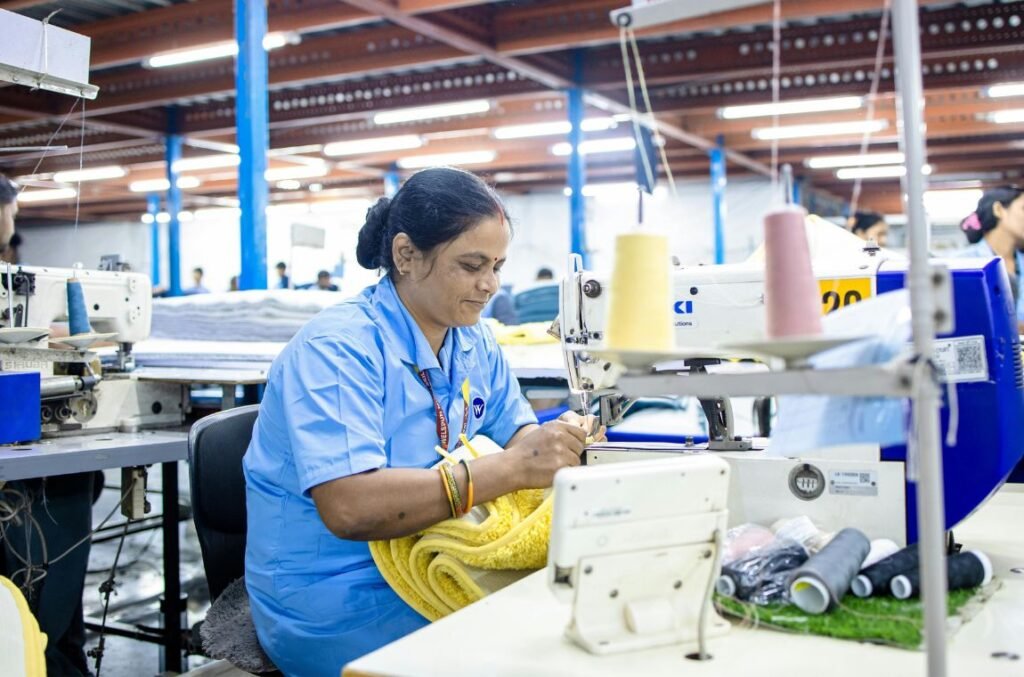
High-volume apparel manufacturing is about more than increasing order sizes. As brands grow, they need manufacturing partners that can balance practical MOQs, scalable production capacity, and fast reorders to keep inventory aligned with demand. With today’s supply chain challenges, choosing a reliable, flexible manufacturer has become a key factor in supporting sustainable growth and long-term business success.
How MOQ Affects Your Growth Strategy
Minimum order quantity influences far more than purchasing decisions. It affects production efficiency, inventory investment, and supply chain planning, making it one of the first factors brands should evaluate when selecting a manufacturing partner.
Understanding Factory Minimums
Factory minimum order quantities (MOQs) help manufacturers distribute setup costs, material sourcing, production planning, and quality control across enough units, keeping production efficient and garment costs competitive.
As Southeast Asia now accounts for 33% of global sourcing value, and over 40% of sourcing leaders plan to expand manufacturing in Vietnam, Bangladesh, and India, understanding factory minimums is becoming increasingly important for brands scaling production.
Avoiding Excess Inventory
Ordering above actual demand can quickly erode profitability through warehousing, markdowns, and obsolete stock. Inventory management has become increasingly important across the fashion industry. McKinsey found that inventory days on hand reached levels 14% higher than pre-2020 averages during 2024, highlighting the financial impact of excess inventory. Other industry estimates suggest that between 10% and 40% of garments produced globally remain unsold, demonstrating why optimized production planning is essential.

Production Capacity: What Buyers Should Measure Beyond Monthly Output
Production capacity should be evaluated by consistency rather than volume alone. Reliable manufacturers combine manufacturing capability, material availability, workforce planning, and quality control to sustain output as demand increases.
Production Flexibility
Monthly production output provides only a partial picture of manufacturing capability. Buyers should also assess whether a supplier can increase production during seasonal demand, accommodate style changes, and allocate additional production lines without disrupting delivery schedules or product quality.
McKinsey reports that demand changes often take months to reach upstream textile suppliers, creating a bullwhip effect that leads to both excess inventory and production shortages. More than 40% of global sourcing executives are increasing production in Southeast Asia, making flexible capacity an increasingly important competitive advantage.
Material Sourcing
Production capacity depends on more than factory output. Reliable access to fabrics, trims, and accessories determines whether manufacturers can begin production on schedule and replenish successful products without unnecessary delays.
Textile Exchange now requires participating companies to report material volumes covering approximately 80% of their raw material portfolio, reflecting the industry’s stronger focus on sourcing visibility. At the same time, recent fashion supply chain analysis found material shortages occurring at the point of order were around 90 times higher than two years earlier, reinforcing the importance of strategic supplier relationships and material planning.
Quality Systems
Maintaining quality across thousands of garments requires standardized operating procedures, trained inspectors, and consistent process controls throughout production. Robust quality systems reduce defects, minimize rework, and help brands maintain customer satisfaction even as production volumes increase.
According to McKinsey, leading apparel brands are strengthening long-term supplier partnerships while investing in better end-to-end collaboration, digital visibility, and standardized manufacturing processes to improve operational resilience and reduce quality risks across the supply chain.
Why Fast Reorders Matter More Than Your First Order
With 75% of apparel brands prioritizing supplier reliability and long-term partnerships expected to reach 51% by 2028, fast, dependable reorders have become more valuable than a successful first production run.
Repeat Orders Without Production Delays
Fast reorders are critical to keeping bestselling products in stock and maintaining sales momentum. Demand fluctuations create supply chain disruptions through the bullwhip effect, while 71% of apparel brands now prioritize supplier consolidation to secure reliable production capacity and faster repeat orders. For growing brands, reorder speed often matters more than the initial production run.
Maintaining Color Consistency
Maintaining color consistency becomes more challenging across large production runs due to variations in dye lots, fabric sourcing, and finishing processes. Even minor differences can affect product quality and customer satisfaction. Brands increasingly strengthen supplier collaboration and vertically integrated manufacturing to improve traceability, ensure consistent production quality, and maintain color accuracy at scale.
Shortening Replenishment Lead Times
Fast replenishment helps brands restock best-selling products before inventory runs out, reducing missed sales during periods of high demand. Manufacturers with integrated sourcing, production, and logistics can respond faster and keep products available when customers are ready to buy.
McKinsey notes that leading ultra-fast fashion supply chains achieve concept-to-customer lead times of 15-21 days, compared with 4-6 weeks for traditional fast-fashion models. Shorter lead times enable faster replenishment and improve supply chain responsiveness.

The Advantages of Working with a High-Volume Apparel Manufacturer
Their operational scale, supplier networks, and standardized processes help brands improve efficiency, reduce sourcing risks, and support long-term business growth while maintaining consistent product quality.
- Lower production costs through economies of scale, reducing unit costs across larger production volumes.
- More reliable production scheduling with dedicated capacity that minimizes delays during peak seasons.
- Stronger material sourcing supported by established supplier networks that improve raw material availability.
- Consistent product quality through standardized manufacturing processes and quality management systems.
- Greater scalability that allows brands to increase production without changing manufacturing partners.
- Improved supply chain resilience through long-term collaboration, better planning, and enhanced operational flexibility.
Key Questions to Ask Before Committing for MOQs Decision
| Decision Factor | High MOQ Appropriate If… | Low MOQ Appropriate If… |
| Capital Availability | Working capital above $50,000 | Limited capital or funds allocated to other investments |
| Sales History | At least 18 months of consistent product sales history | New product launch or under 12 months of operating history |
| Inventory Infrastructure | Warehouse facilities and inventory systems already established | Limited warehouse space or manual inventory management |
| Risk Tolerance | Comfortable with 6-12 month inventory turnover cycles | Require faster inventory turnover within 3-6 months |
| Growth Stage | Expanding established products into additional markets | Testing product-market fit or refining product designs |
How Capital World Group Supports Long-Term Production Growth
As fashion brands grow, they need manufacturing partners that scale efficiently. Capital World Group combines vertically integrated production, experienced teams, and standardized quality systems to support reliable, high-volume apparel manufacturing.
As full owners of their Kiara Garments factory, 18 production lines, 800 skilled employees, a sample turnaround of approximately 10 days, and minimum order quantities starting from 5,000 pieces per style, Capital World Group supports efficient high-volume production. Its end-to-end manufacturing model, from fabric sourcing and sampling to quality control and export, enables brands to streamline operations, improve production visibility, and build long-term sourcing partnerships.