
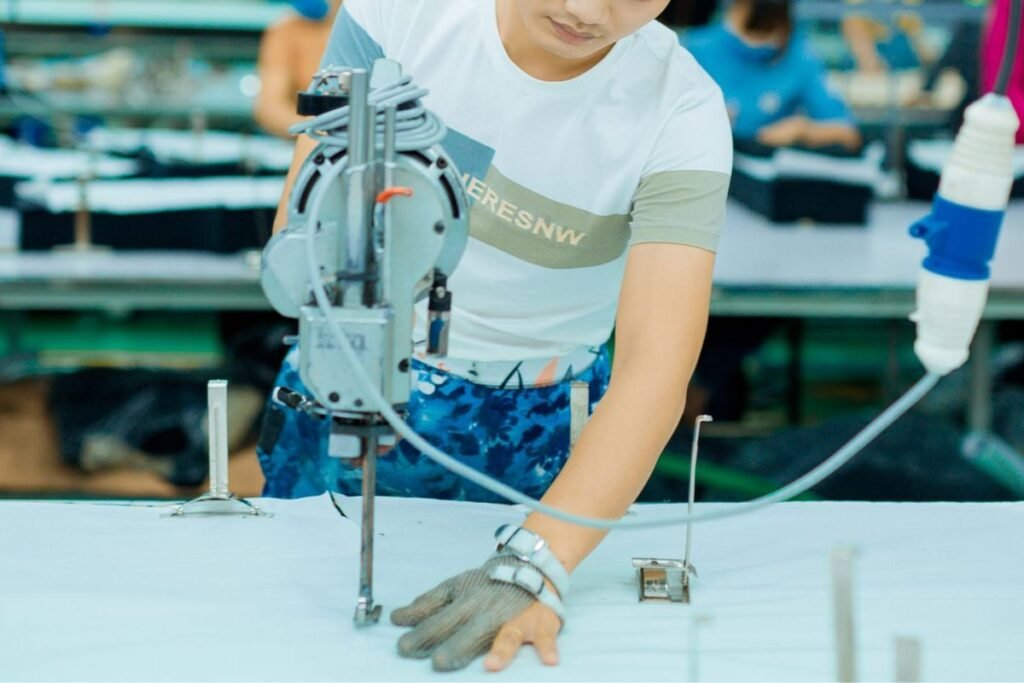
Vietnam’s garment sector employs over three million workers. That number tells you the industry’s scale. It does not tell you much about skill depth, which is what actually determines whether your production runs smoothly or not.
Here is what matters when evaluating a manufacturer’s workforce capability.
The Skills Gap Is Real and Well-Documented
Vietnam’s garment industry has historically operated under a Cut-Make-Trim (CMT) model, which accounted for the majority of total exports and concentrated manufacturing effort on production execution rather than material sourcing, design, or branding. (source: Abacademies)
This does not mean factories are poorly run. It means the skills most critical to quality — QC, production management, lean processes, technical fabric handling — are concentrated in experienced factory operators rather than distributed broadly across the labour pool. For sourcing managers, this makes supplier selection more consequential than it might be in markets with standardised vocational pipelines.
What Is The Vietnam Garment Industry Doing About The Skills Gap
The gap is not static. Manufacturers across Vietnam are investing in upskilling their workforce with training in modern equipment operation, quality control, and digital processes, and are collaborating with industry associations and educational institutions to prepare workers for the demands of a modern textile sector.
The Vietnamese government supports this through funded employee training programmes and additional tax reductions for companies hiring local labour – creating an incentive structure that rewards factories investing in their people.
Automation and digital tools are also playing a role, freeing skilled workers from repetitive tasks to focus on complex work and quality control. The factories absorbing these tools fastest tend to be the ones already operating with a strong internal training culture, another signal worth probing during supplier vetting.
What “Skilled Workforce” Means in Practice
When manufacturers describe their workforce as skilled, sourcing managers should ask what that means specifically. Skill in garment manufacturing is not monolithic. There is a meaningful difference between:
- Assembly-line sewing proficiency is high across Vietnam’s established factories
- Pattern and sampling capability: more concentrated; look for in-house pattern rooms and dedicated sample teams
- QC and finishing discipline: varies significantly; ask about rejection rates and in-line inspection processes
- Fabric and trim knowledge: strongest in manufacturers with direct sourcing relationships and long supplier histories
Vietnam’s history in the garment industry has cultivated a labour pool proficient across cutting, sewing, and finishing techniques, but the optimal balance of skill and cost varies depending on the manufacturer, not just the country.
This is the practical question for any sourcing manager: Does this specific factory have the skill depth to handle your product category at your quality standard?
Ninh Binh (formerly Nam Dinh): A Region Built Around Textile Skill
Not all of Vietnam’s manufacturing regions carry equal depth. Ninh Binh (formerly Nam Dinh), in the north, has a specific advantage worth noting. It is one of Vietnam’s longest-established textile hubs, with generational expertise in fabric and garment production. This industry culture translates into a more experienced and stable local labour pool compared to newer industrial zones.
Capital World Group’s Kiara Garments factory operates in Ninh Binh (formerly Nam Dinh) with 800 staff across 18 production lines, applying lean processes and automated systems to ladies’ knit and woven apparel.
The Questions Worth Asking Any Manufacturer
Before committing to a supplier, workforce capability is worth probing directly. Useful questions include:
- What is your staff turnover rate, and how do you manage continuity on production lines?
- Do you run in-house training programmes, or do you rely on external hires for skilled roles?
- How is QC structured — end-of-line only, or in-line at multiple stages?
- Can I see your sampling team’s output and turnaround records?
- What is your rejection rate on bulk production, and how do you handle remediation?
The answers tell you more than a headcount figure. A factory with 500 workers and a structured QC process will consistently outperform one with 2,000 workers and ad hoc inspection.
What This Means for Your Sourcing Decision
Vietnam’s garment manufacturing workforce is genuinely strong in production fundamentals. The workforce in Vietnam’s textile sector is known for being skilled, adaptable, and hardworking. That reputation is broadly earned at the experienced-operator level. If you are evaluating manufacturers for ladies’ apparel production in Vietnam, contact Capital World Group to discuss your production requirements. Capital World Group serves global apparel brands seeking a Vietnam garment manufacturer with end-to-end supply-chain control.